

Fix the two weak spots on the outside, then hold the door from the inside. Swap the exposed hinge pins for non-removable or security-stud hinges, and cover the latch gap with a latch guard. Then add something inside that ties the door to the floor or across the frame. A wedge or a jammer under the knob will not help, because a door that opens outward pulls away from it.
Why does a door that opens outward need different security?
Because it gets beaten a different way. An inward door gets kicked: the force drives the door into the room and splits the frame at the strike. An outward door closes against its stop, so a kick from outside mostly pushes it tighter into the frame. Bob Vila's guide calls them much more difficult to kick in than inward-swinging doors.
The trade-off is what sits on the outside. The hinges face out, so their pins can be tapped up and pulled, and the door lifted off the hinge side even with the deadbolt thrown. The latch sits in the gap between the door and the frame, where a pry bar or a thin shim can reach it. So the attack on an outward door is a pry or a pull.
You find these doors on commercial exits, garage and side entries, homes built for hurricane winds, and some apartments.
Bill Barna, who invented the Bolo Stick after 33 years as a police officer, puts door security in terms of layers. One lock, he says, is easy to defeat. Four or five layers can't be beaten without someone seeing or hearing it happen. The three steps below are three layers: the hinges, the latch, and a hold on the door from inside.
Step 1: Lock the hinges
On an outward door the hinge pins are on the outside. Pull the pins and the door comes off the hinge side. Fix that first, and pick one of these:
- Non-removable pin (NRP) hinges. The pin is held in place and can't be driven out while the door is closed.
- Security stud hinges. A steel stud on one leaf drops into a hole in the other when the door shuts. Even with the pin gone, the door can't be lifted out.
- Hinge security pins. The retrofit. Replace one screw on the door leaf with a headless pin, drill a matching hole in the frame leaf, and you get the same effect as a stud hinge.
Replacement hinges come in standard sizes. Measure the height, corner shape and screw pattern of the old ones before you buy, as a DIY Stack Exchange thread on outward front doors points out.
Step 2: Cover the latch
A latch guard is a metal plate screwed to the outside of the door that covers the gap over the latch. It stops a pry bar or a shim from getting at the bolt, and it is quick to put on.
While you're at the latch, check the lock itself. A deadbolt holds better than a knob latch. A latch guard over a cheap knob lock is still a cheap knob lock.
Step 3: Hold the door from the inside
This is where most advice goes wrong. Door jammers, wedges and the adjustable bars that sit under a doorknob all work by bracing against a push. On an outward door nobody is pushing. The door swings away from the room, so it pulls straight off a wedge or a jammer. Bob Vila's guide makes the same point: the usual door security bars and floor barricades won't be as effective on these doors.
What works on an outward door is anything that ties the door to something fixed: the floor, or the inside face of the frame.
A pin from the door into the floor
This is how the Bolo Stick door barricade works. A steel Safety Block is screwed to the inside face of the door, near the bottom and under the handle. A Safety Anchor sits flush in a small hole in the floor beneath it. In an emergency you drop the steel Safety Pin through the block and into the anchor. The door is now pinned to the floor, so it can't swing in or out.
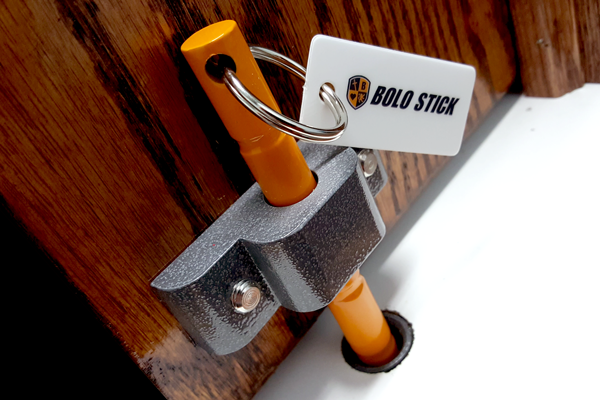
The Bolo Stick always installs on the inside of the door, whether the door opens in or out. The Bolo Stick is 1045 cold-rolled steel, independently tested to more than 4,200 pounds of force. The commercial and residential models are $69 each.
On the commercial model, two screws go through the door from the outside and thread into the block, so the screw heads sit on the outside face. On an outward door that is the side an intruder stands on, so they are tamper-resistant security screws that need a special bit to turn.
A bar across the inside of the frame
An outswing security bar is a bar fixed to the door, plus a second bar wider than the opening that is pulled tight against the inside of the frame. To open the door, someone outside has to rip the bar through the frame. Homeowners build the same idea with two L brackets on the door and a length of wood or steel longer than the door is wide.
A bar holds well. It also stays in view, and it has to be taken down every time you use the door.
Flush bolts and barrel bolts
A bolt on the inside of the door that shoots into the frame or the floor gives you a second lock point. A barrel bolt is the simplest version, often used on garage and side doors. How much it holds depends on its size and on what its screws bite into.
The stopgap: tie the handle to something heavy
With no hardware at all, you can tie the door handle to a piece of furniture too heavy to drag. Use a belt, a chain or a cord. It is only as strong as the handle and the tie, and it takes time to rig, so treat it as a fix for tonight, not a plan.
Outward door security options compared
| Hinge pins and studs | Latch guard | Floor pin (Bolo Stick) | Bar across the frame | Door jammer or wedge | |
|---|---|---|---|---|---|
| What it stops | The door lifted off its hinges | The latch pried or shimmed | The door swung open | The door swung open | Nothing on an outward door |
| Where it goes | Hinge side, both leaves | Outside face, over the latch | Inside face of the door, plus a hole in the floor | Inside face of the door and frame | The floor, inside |
| Drilling | Small holes in the hinge leaves | Screws through the door | Holes through the door and one in the floor | Screws into the door, or brackets | None |
| Ready to use | Always on | Always on | Drop the pin in, one step | Set the bar in place | Not effective here |
| Works on inward doors too | Yes | Yes | Yes | Inward doors use a different bar | Yes |
Most outward doors need the first two, which stay on all the time, plus one way to hold the door shut from inside when it counts.
Outward-opening doors at school and at work
A lot of lockdown plans still tell staff to stack desks, chairs and filing cabinets against the door. Bill Barna has called that labor-intensive, and elementary kids can't help move furniture. On a door that opens out into the hallway the pile does not hold anything at all, because the door swings away from it.
A barricade for a classroom or office door has to work in one motion, under stress, by whoever is in the room. The Bolo Stick is one pin into one hole. The commercial model also lets first responders release it from outside the room. See how schools use it on the school door barricade page, and offices on the business page.
Rules on door barricades in schools and businesses vary by state and by building. In 2016 the Trumbull County Chief Building Official found the Bolo Stick met the 2011 Ohio Building Code when used as designed (read the letter). Ohio's rule also requires documented staff training. Confirm with your local building, fire and law enforcement officials before you install.
Getting out fast
Anything that holds a door shut has to come off in one step from inside. Everyone who uses the room should know how to clear it in the dark. The Bolo Stick pin lifts straight out.
The Bolo Stick is for emergencies. Leave the pin out in daily use and keep it in reach, so the door works as a normal exit until you need it.
Frequently asked questions
Yes, but not with a wedge or a jammer. You need something that ties the door to the floor or across the inside of the frame, such as a floor-anchored pin or an outswing security bar.
No. A jammer braces against a door being pushed into the room. An outward door is pulled the other way, so it simply moves off the jammer.
A good deadbolt behind a latch guard, on hinges with non-removable pins or security studs. Add a floor pin or a frame bar inside for the times you need the door held shut.
Pin it to the floor or bar it across the frame from inside. A barrel or flush bolt into the frame or floor adds a second lock point. Tying the handle to heavy furniture works as a short-term fix.
Most real fixes for an outward door need screws in the door, the hinges or the floor. Ask your landlord first. Without approval, the furniture tie is the no-drill option, and it is a stopgap.
Yes. It installs on the inside of the door either way, and the same unit fits inward and outward doors. See the installation guide.
1045 cold-rolled steel, independently tested to more than 4,200 pounds of force, one step to set. Invented by Bill Barna, a retired police officer with 33 years in law enforcement.
See the Commercial Door BarricadeSecuring a home? See the residential door barricade.